Culture
Razaq Thoughts / Essays & reflectionsWhat Changes When We Stop Standing Outside the System?
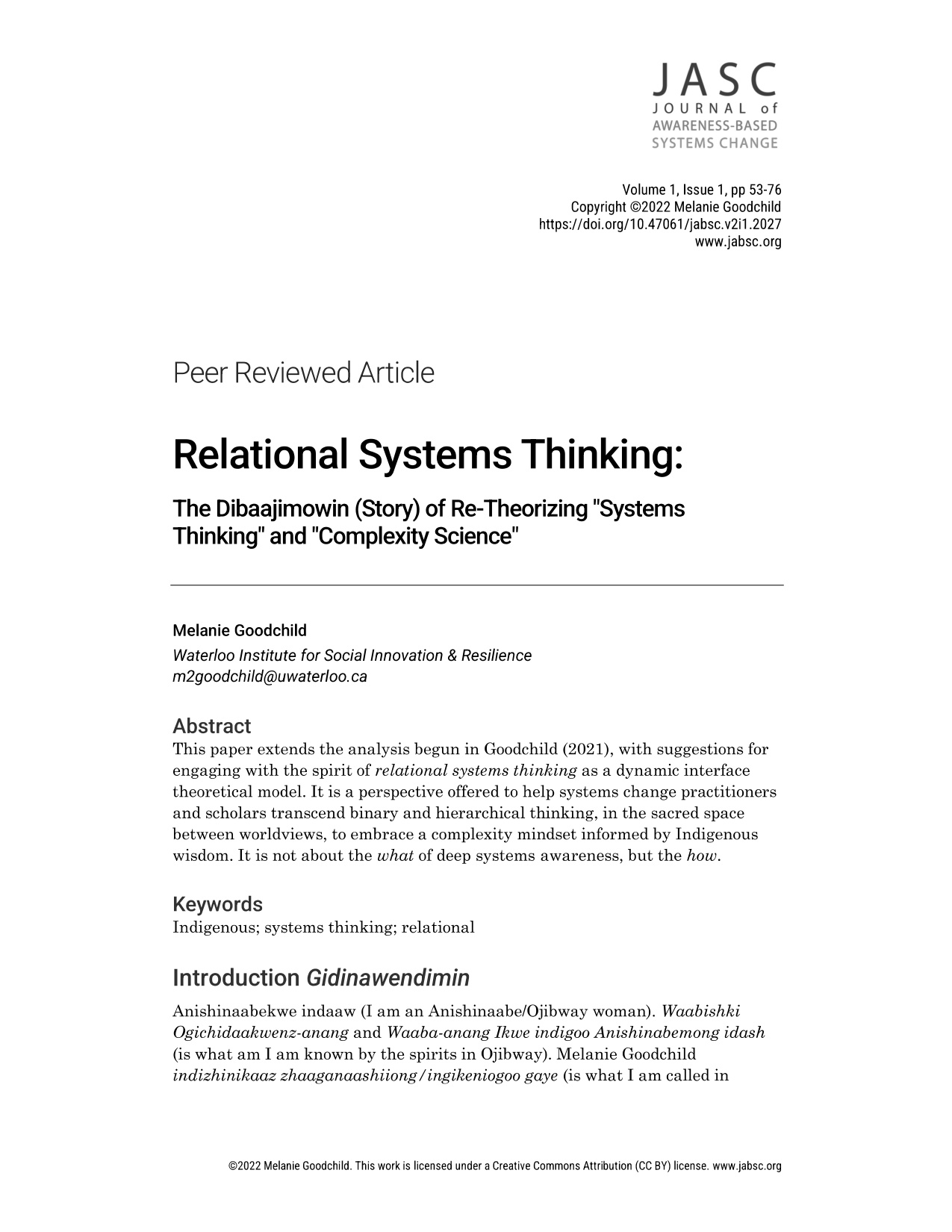
Melanie Goodchild’s article, “Relational Systems Thinking: That’s How Change Is Going to Come, from Our Earth Mother,” made me rethink a common idea: that understanding a system means identifying its components, their relationships, and feedback loops.
- Written by
- RASAQ RAIMI
- Published
- Reading time
- 3 min read
What Changes When We Stop Standing Outside the System?
Melanie Goodchild’s article, “Relational Systems Thinking: That’s How Change Is Going to Come, from Our Earth Mother,” made me rethink a common idea: that understanding a system means identifying its components, their relationships, and feedback loops.
The article begins from the broader context of systems thinking, encouraging us to move beyond isolated problems and examine relationships, feedback, and underlying structures. Goodchild deepens this perspective by asking us to consider our own position within the systems we seek to understand.
That distinction matters.
A river, for example, can be represented as a system of water flows, ecological interactions, infrastructure, users, and regulatory institutions. While such analysis is useful, it may still say little about what it means to be in relationship with that river: who bears responsibility for it, whose histories are tied to it, what obligations extend to future generations, and what forms of knowledge emerge from living with it.
Goodchild develops this discussion through conversations with Haudenosaunee Elders and Knowledge Keepers and Western systems thinkers. The Haudenosaunee Two-Row Wampum is significant. Two vessels travel along the same river without one attempting to steer the other. They remain distinct, yet they also share responsibility for the river that makes their journeys possible.
I find the Two-Row Wampum image powerful because it complicates collaboration. Working together does not necessarily require becoming the same, thinking the same way, or absorbing one perspective into another. Relationships can involve both difference and interdependence.
This also changes how I think about sustainability.
Many sustainability challenges are framed as problems that require better technologies, stronger institutions, improved incentives, or more accurate information. All of these may be necessary. But relational systems thinking raises another question:
What is the quality of the relationships within the system we are trying to change?
A technically successful intervention may still leave damaged relationships untouched. A project may achieve measurable environmental outcomes even as communities remain excluded from meaningful decision-making. A model may accurately describe interactions while overlooking responsibilities that cannot be easily represented as variables.
For me, the lesson is not to abandon systems analysis. It is to deepen it.
Perhaps sustainability requires us to ask not only how the system works, but also:
Where am I located within it? What relationships sustain it? What responsibilities follow from those relationships? And what becomes invisible when I imagine myself standing outside the system?
Goodchild’s work reminds us that meaningful systems change may begin not only with seeing connections, but with learning how to live responsibly within them.
Reflection on Melanie Goodchild (2021), Relational Systems Thinking: That’s How Change Is Going to Come, from Our Earth Mother
#RelationalSystemsThinking #Sustainability
#SystemsThinking #IndigenousKnowledge
#TwoRowWampum #WaysOfKnowing
#SustainabilityLeadership
Work Under Review
Relational Systems Thinking: That’s How Change Is Going to Come, from Our Earth Mother
- Original author
- Goodchild (2021)
- Goodchild (2021)_compressed.pdf
The original work discussed in this article.
Room for another perspective
Join the discussion
What stayed with you? What would you question? Thoughtful disagreement and shared experiences make a good article the start of a conversation.
A note on comments: engage with ideas, respect people, and give reasons for your point of view.
The river example shows how much a systems diagram can leave out. Flows, users and regulations are all representable. Obligation to future generations and the histories tied to a place are not variables, yet they shape how people behave within the system.