Philosophy
Razaq Thoughts / Essays & reflectionsWhat If the Land Is Also a Teacher?
We often confine serious learning to university classrooms, books, formal instruction, and recognized experts. The author of Land as Pedagogy invites us to consider a very different understanding. Writing from a Nishnaabeg context, Simpson shows that learning can also emerge from the land, relationships, observation, experience, community, language, spirituality, and practice.
- Written by
- RASAQ RAIMI
- Published
- Reading time
- 3 min read
What If the Land Is Also a Teacher?
Leanne Betasamosake Simpson’s article, “Land as Pedagogy,” made me reflect on a question we rarely ask in conventional education: Where does knowledge come from?
We often confine serious learning to university classrooms, books, formal instruction, and recognized experts. The author of Land as Pedagogy invites us to consider a very different understanding. Writing from a Nishnaabeg context, Simpson shows that learning can also emerge from the land, relationships, observation, experience, community, language, spirituality, and practice.
Her story of Kwezens brings this understanding vividly to life.
Kwezens’s learning process does not begin with a textbook, a lecture, or a formal lesson. She learns through curiosity, attention, experimentation, and relationships. She learns with and from maple trees and from the community around her, where knowledge is modeled in everyday interactions with creation. Simpson describes this as more than “land-based education.” Her argument goes deeper: the land must become the pedagogy.
That distinction matters.
If we treat land only as the place where learning occurs, it remains little more than a backdrop. Simpson invites us to understand something deeper: land is not simply a setting for learning but part of the relationship that makes learning possible. From this perspective, knowledge is not produced only within institutions and then applied to the world. It can also emerge through living, observing, participating, listening, practicing, and sustaining relationships with the land and the beings who share it.
Simpson’s discussion of aki deepens this idea. Within the Nishnaabeg worldview she describes, aki is profoundly relational, encompassing landforms, plants, animals, spirits, sounds, thoughts, feelings, energies, ecologies, and the networks that connect them. Knowledge, therefore, cannot be easily separated from the relationships through which it is generated.
This raises an important question for sustainability.
Much environmental thinking understandably relies on observation, measurement, management, and intervention. Simpson invites us to consider another possibility: what might change if we understood ourselves not only as observers of environmental relationships, but as participants within the relationships we are trying to sustain?
Her discussion of Nanabush makes this insight even more practical. In this account, learning requires engagement. One learns by going out, observing, experimenting, visiting, building relationships, and becoming invested in the world one seeks to understand. Simpson presents this not merely as a method of acquiring information but as part of learning to live responsibly within a specific relational context.
Perhaps this is one of the deeper lessons sustainability can take from Indigenous knowledge traditions:
We may not learn how to care for the Earth only by studying it from a distance.
Some knowledge may require presence.
Some understanding may require relationship.
And some responsibilities may only become visible when we learn to pay attention differently.
Simpson’s work therefore leaves us with a question that goes beyond education:
If the land can teach, are we still capable of listening?
#IndigenousKnowledge #LandAsPedagogy
#Sustainability #IndigenousWaysOfKnowing
#EnvironmentalLearning #Relationality
#LeanneSimpson
Work Under Review
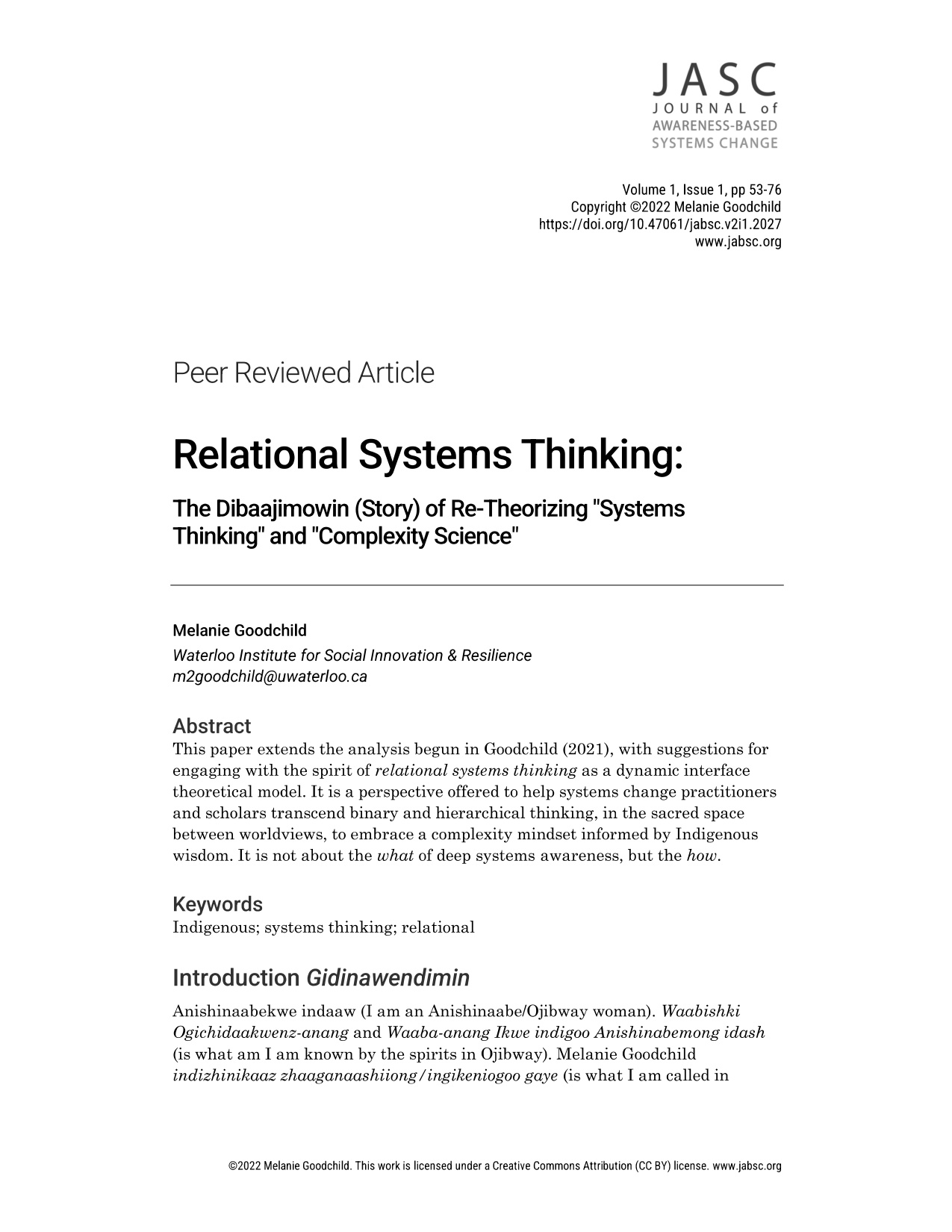
Land as pedagogy: Nishnaabeg intelligence and rebellious transformation
- Original author
- Simpson, L. B. (2014)
- Simpson, L. B. (2014).pdf
The original work discussed in this article.
Room for another perspective
Join the discussion
What stayed with you? What would you question? Thoughtful disagreement and shared experiences make a good article the start of a conversation.
Would you expand on the role of community in Kwezens’s learning? I am curious about how individual discovery becomes shared understanding.
I agree that distance can hide responsibilities. Measuring an ecosystem and depending on it in everyday life can make different questions feel urgent.
I read the final question about listening as an ethical question, not just an observational one. Paying attention might require giving up the expectation that the world exists for our use.
I would resist treating every form of proximity as understanding. Someone can spend years in a place without listening carefully to the people or other beings there.
The maple-tree story makes me wonder about patience in education. Curiosity and seasonal change may not follow a timetable designed around short teaching units.
The distinction between learning on the land and learning through a relationship with it is the heart of this piece. Moving a classroom outdoors would not necessarily change who or what counts as a teacher.
Kwezens learning with maple trees gives curiosity a much more active role than simply receiving a lesson. I like that experimentation and community appear together rather than as competing explanations.